

On the occasion of the Welcome to Napoli design competition, Lamberti Design participated as a technical sponsor in the creation of Napoli Velata, a project by designer Diego Benito De Filippis, which was awarded within the competition. The intervention operates in a hybrid territory, halfway between urban furniture and artistic installation, capable of engaging with public space in both a critical and poetic way.
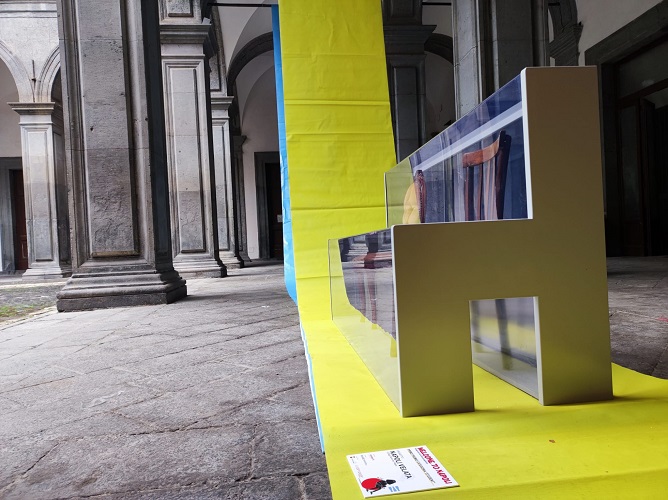
Napoli Velata was conceived as an object of critical design, where function intertwines with meaning. It is not simply a bench, but a narrative device that invites reflection, encouraging a deeper reading of the city and its contradictions. The project uses concrete as an expressive and cultural language, transforming it from a construction material into a symbolic medium, rich in references and layers.
From a production standpoint, Lamberti Design contributed to the realization of the seating by developing the metal side structures and the transparent press-bent plexiglass elements. The sides of the bench, rigorous and minimal, enclose and subtly reveal historical chairs within, acting as a silent evocation of collective memory and Neapolitan domestic tradition.
The result is a sculptural and provocative object, where transparencies, solids, and voids create a visual and conceptual dialogue with those who observe and use it.
Design Competition: “Welcome to Napoli”
The “Welcome to Napoli – Design for a Welcoming City” ideas competition, launched as part of Naples Design Week, seeks innovative and targeted solutions that stand out for their adaptability, manufacturability, inclusivity, effectiveness, and efficiency.
For the 2025 edition, participants were asked to design a collective urban seating element to be placed in public and open spaces. Beyond its basic function, the piece was intended to encourage interaction and dialogue among users. The seating also had to be multifunctional, welcoming, and inclusive—a place for temporary rest, social exchange, experience, and storytelling.
Proposals were required to be adaptable to different contexts (historic centers, squares, stations, waterfronts, peri-urban areas, parks, etc.) and to address issues of feasibility, maintenance, performance, and overall durability (resistance to wear, theft, vandalism, and weather conditions).
Meaning of the Work and the Award Motivation
“The proposal, with its evident poetic and communicative strength, reinterprets the theme of ‘Neapolitan identity’ by freeing it from stereotypes, clichés, and predictable iconography. The project is therefore appreciable for its overall expressive quality and its speculative dimension, typical of critical design, which aims to establish a possible semantic dialogue between urban furniture and urban art installation.”
The concept of the work connects the two souls of Naples—the popular and the bourgeois—merging them into a single design gesture. This approach offers an image of the city freed from stereotypes and conventional iconography, reinterpreted through a contemporary, conscious, and cultured vision.